Is it safe to pay online ?
5 keys to protecting your business when paying online
More and more companies are choosing to pay their suppliers online or receive money from abroad. Digitalisation is here to stay, and in today's business environment, online payments are synonymous with speed, convenience and control.
However, many companies are still wondering: Is it really safe to pay online? Can I trust that my money will reach its destination without risks?
The answer is yes. Paying online can be completely safe, provided it is done in an informed manner, with trusted platforms and by applying good cybersecurity practices.
Here are 5 essential keys to protect your company's finances when making digital or international payments.
1. Use reliable platforms with full traceability
The first step to paying online securely is to choose a reliable payment platform. Not all of them offer the same guarantees.
A good platform should:
- Comply with international security standards (such as PCI DSS).
- Offer end-to-end encryption to protect your transaction data.
- Use tokenisation, which replaces real banking data with random codes that are impossible to reuse.
- Clearly show each transaction and its status, from sending to receipt of payment.
The safest platforms offer full traceability, which allows you to track your money step by step. Knowing at all times what is happening with your funds is the best guarantee of trust and control.
Additionally, make sure the service has human support and direct assistance. Being able to contact a specialist with any questions or issues makes the difference between a secure payment and a vulnerable one.
2. Enable two-step authentication (2FA)
When you pay online, security doesn't end with the platform: It also depends on how you access it.
Activate two-step authentication (2FA) on all accounts that handle payments. This system adds an extra layer of security: In addition to the password, it requests a temporary code sent via SMS or app.
So, even if someone gets hold of your password, they won't be able to access it without that second verification factor.
Use this system also in your email accounts or tools related to payment management. Each additional layer reduces the risk of unauthorised access or theft of credentials.
3. Protect your devices and connections
Many threats when paying online do not come from the platform itself, but from the environment from which you carry out the transaction. Keeping your devices and networks secure is key.
Essential measures:
- Update your operating system and browser frequently.
- Install and keep a professional antivirus active.
- Avoid transfers from public or passwordless Wi-Fi networks.
- If you work remotely, use a VPN to encrypt the connection.
- Limit access to the devices used to make payments.
An outdated computer or an insecure network can be the gateway for a cyberattack. Digital security starts with daily maintenance.
4. Train your team in digital security
Technology protects, but people prevent. Many online scams begin with human error: Opening a fake email or transferring money without verifying the recipient.
Training your team is an investment, not an expense.
Basic good practices:
- Training on how to recognise fraudulent emails or messages (phishing).
- Require double verification before sending money to a supplier.
- Establish an internal protocol to authorise high-value payments.
- Ensure that each transaction is recorded with its supporting documentation.
Creating a security culture in the company drastically reduces the risk of fraud. When everyone is aware of good practices, trust multiplies.
5. Use virtual cards and tokenised methods
One of the safest ways to pay online is with virtual cards or tokenised systems.
Virtual cards are generated for a single purchase or provider, with a limited amount. Thus, if a fraud attempt occurs, the impact is minimal.
Tokenisation, on the other hand, replaces real bank details with non-reusable random codes. Even if someone gains access to that code, they will not be able to steal your funds or your data.
These solutions offer greater security and control in international payments, ideal for companies that operate with multiple suppliers.
Extra: design an incident response plan
Even if you take every precaution, no system is infallible. Therefore, it is advisable to have a clear plan in place for possible fraud attempts or suspicious transfers.
Your response plan should include:
- A designated person in charge of responding to incidents.
- Steps to block transactions and contact the platform.
- Immediate communication with the affected supplier.
- Recording and analysing the incident to prevent recurrence.
The speed of response can make the difference between a simple alert and a serious loss. Having a plan reinforces confidence and demonstrates that your company is prepared for any eventuality.
Conclusion: Paying online is safe if you take control
Paying online shouldn't be a source of worry, but rather a growth tool.
Companies that use reliable digital platforms gain in speed, efficiency, and control.
The key is to combine technology and security culture:
- Platforms with traceability and encryption
- Reinforced authentication
- Protected devices
- Trained personnel
- Clear protocols in the event of incidents
With these five keys, paying online ceases to be a risk and becomes a real competitive advantage.
In an increasingly global and digital world, trust and security are the true drivers of success.
Paying online is the future. Doing it safely is the real breakthrough.
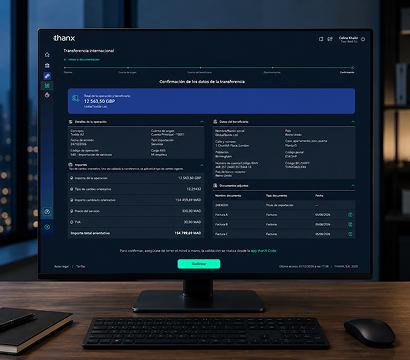
How to send money abroad from Morocco: Practical guide for companies
Learn about the available options, local regulations, and best practices for sending money abroad safely and efficiently.
Dirham to euro exchange rate: Keys to protecting your business
If you operate in Morocco and need to convert dirhams to euros, we explain how the exchange rate works, which factors affect it, and how to avoid unnecessary losses.

Keys to making international transfers from Morocco
Discover how to make international transfers from Morocco securely and efficiently. Learn about the requirements, costs, time frames, and how to simplify the process.
How to make payments to international suppliers from Morocco
Discover how to make payments to international suppliers from Morocco. Learn about the available methods, the applicable regulations, and how to manage your operations securely and efficiently.
Your money,without borders
Join thanX